From Map Rank 13 to #1 on Google Maps in 90 Days
How a small junk removal and disaster cleanup company in San Antonio, Texas started outranking national brands with 3,000 times more backlinks, without spending a dollar on ads.
What this campaign achieved
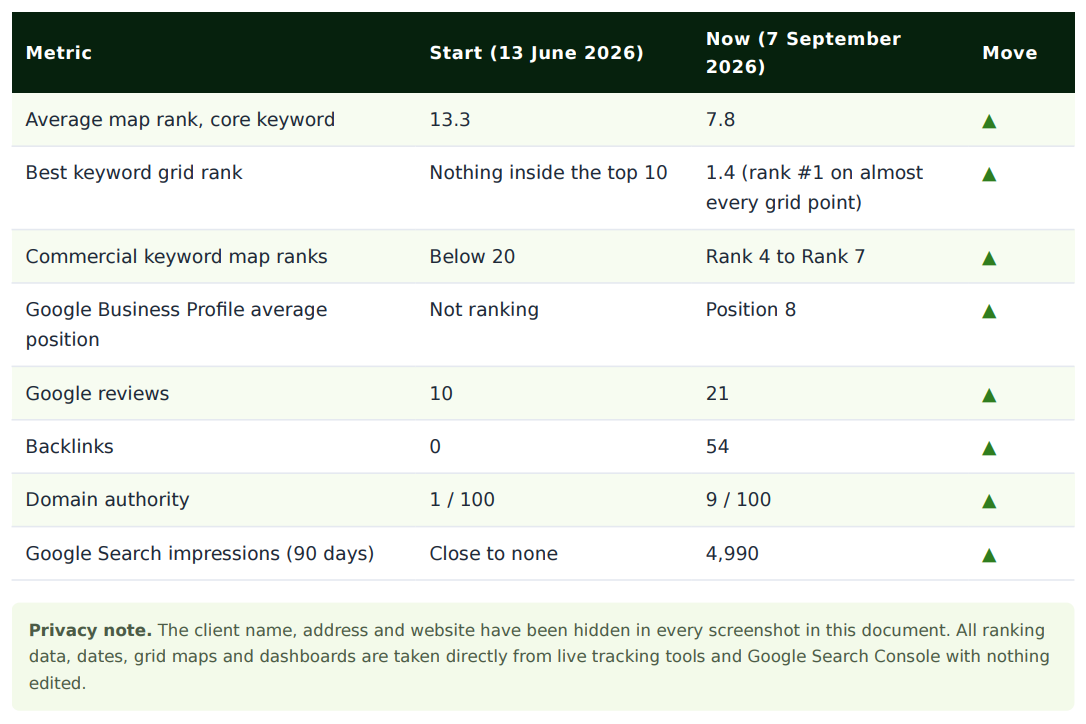
A veteran owned junk removal and disaster cleanup company in San Antonio came to us with a website almost nobody could find. It had no backlinks, a domain authority of 1 out of 100, ten Google reviews, and an average map rank of 13.3 for its main keyword. In plain terms, customers searching for junk removal in San Antonio never saw them.
San Antonio is one of the hardest junk removal markets in the United States. National brands like 1-800-GOT-JUNK, LoadUp, Junk King and The Junkluggers all fight for the same three map spots, and most of them carry thousands of reviews and tens of thousands of backlinks.
Ninety days later, the same profile ranks number one across almost the entire city grid for high value commercial searches, and it now sits above several of those national brands on Google Maps.
A business that was invisible on the map
We began with a local grid scan on 13 June 2026 for the keyword junk removal san antonio. A grid scan places a simulated searcher at dozens of points across the city and records where the business shows up on Google Maps at each point. Every red pin below means the business ranked between 11 and 20, which is deep enough that almost nobody scrolls that far.
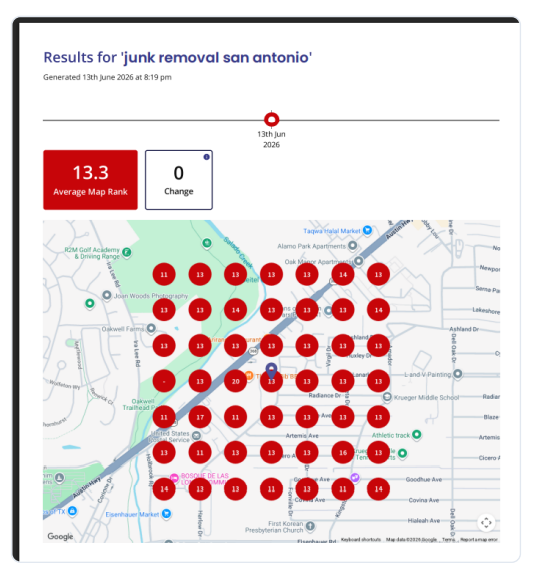
13 June 2026. Average map rank 13.3 for "junk removal san antonio". Every point on the grid is red, and the change indicator reads zero. The business was stuck.
What was holding the site back
Our audit found a long list of problems, and most of them were basic:
- Live service pages still carried placeholder and wrong content
- Footer links pointed to a development environment and were broken
- Name, address and phone details did not match across listings
- The site was effectively not indexed, so Google had very little to rank
- No backlinks at all and a domain authority of 1 out of 100
- Thin service pages with no supporting content behind them
- The Google Business Profile was missing categories, service areas and photos
The real challenge
The competition was not a few local operators. It was national franchises with marketing budgets, call centres and link profiles built over a decade. Beating them on raw authority was never going to happen in 90 days. We had to win on relevance, proximity and trust signals instead.
Five things we did, in order
There was no single trick here. We ran a complete local SEO system and kept the order strict, because fixing content before fixing indexing is wasted work.
1. Fix the foundation
Cleaned up crawling and indexing, rebuilt the site structure, repaired the broken links, submitted a proper XML sitemap and made sure every important page could actually be reached. Until Google could read the site properly, nothing else would move.
2. Rebuild the money pages
Every service page got a new title tag, meta description, header structure and keyword placement built around how San Antonio customers actually search. We added schema markup so Google could understand the service, the area and the business type without guessing.
3. Turn the Google Business Profile into the main asset
For a local service business, the map pack matters more than the website. We set the primary and secondary categories correctly, defined the service areas across Bexar County and the surrounding suburbs, matched the business details everywhere they appeared, added photos, and put a simple review request process in place. Reviews went from 10 to 21 while the rating stayed at 4.9.
4. Build topical depth with content
We mapped out a 328 article content plan across 35 topic clusters, then published it in priority order instead of all at once. The first cluster covered pricing and cost questions, because those are the searches closest to a booking. Each article was written for the customer first and linked back to the service page it supported.
5. Build local trust signals
Consistent citations, local directory listings, and a link building push that leaned on the veteran owned angle, which gave us a genuine reason for local sites to link. We went from zero backlinks to 54, and domain authority moved from 1 to 9.
Why the order matters. Most local SEO campaigns fail because they start with content and links while the site is still broken underneath. We spent the first weeks on technical repair and profile setup, which is why the ranking movement came in the second and third month rather than slowly over a year.
Month two: the map starts moving
By 30 July the picture had changed completely. The same grid that was solid red in June was now mostly green, and the profile was holding rank #1 for demolition debris removal san antonio tx across the centre of the city.
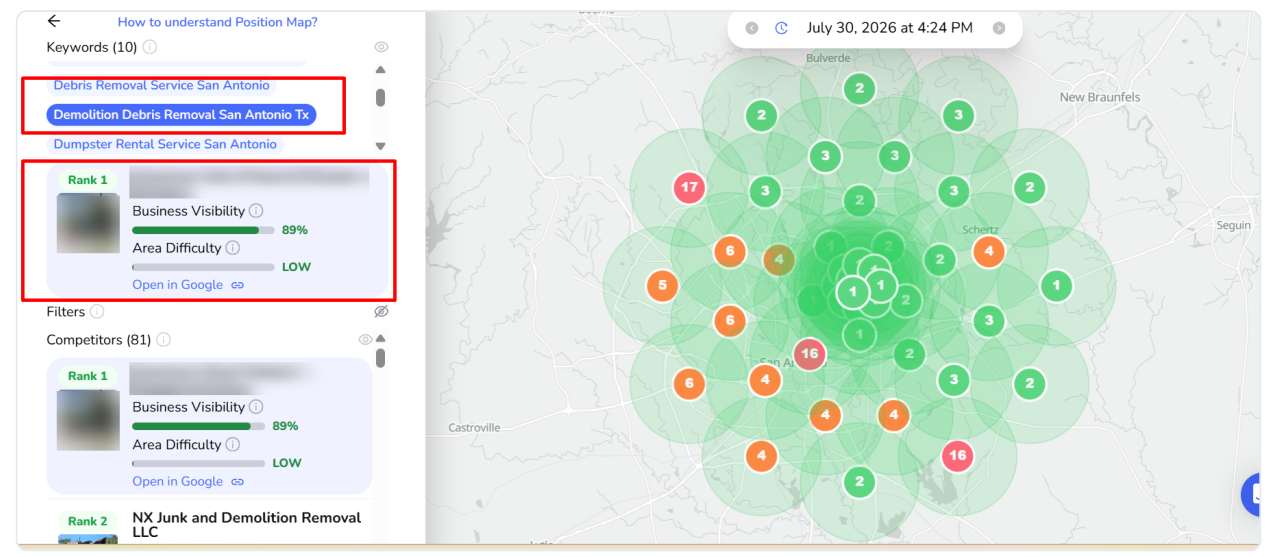
30 July 2026. Rank #1 on the tracked grid for a high value commercial keyword. Green points are top three positions. Area difficulty for this term is still rated low, which is exactly the kind of gap a small business should attack first.
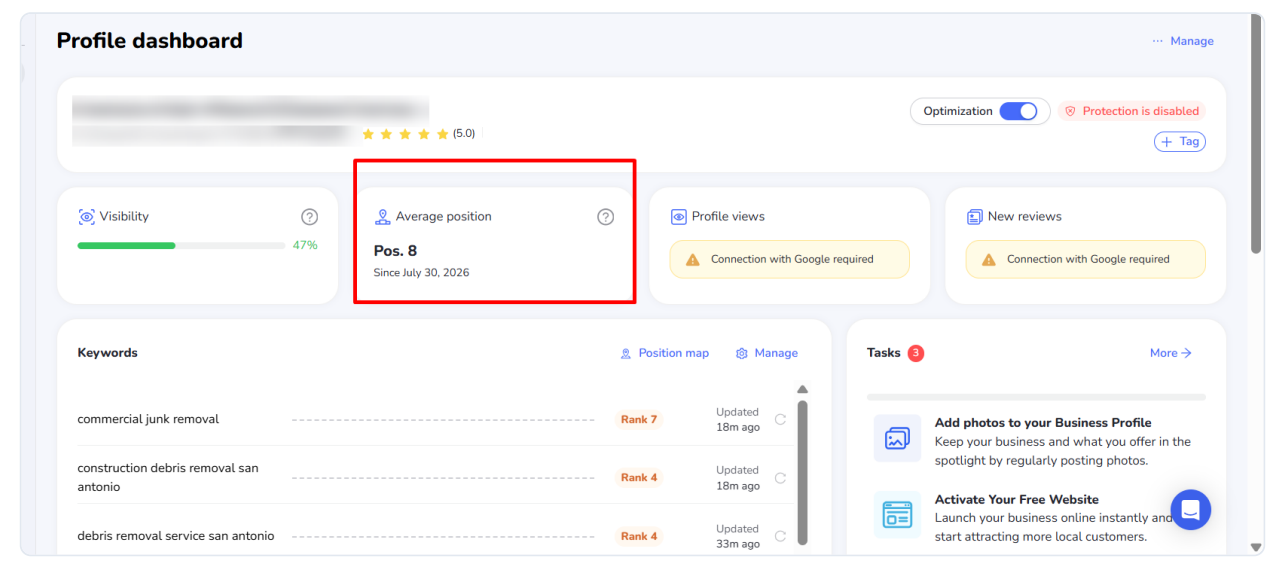
Profile dashboard, 30 July 2026. Average position across all tracked keywords moved to position 8, with a 5.0 star profile rating. The three keywords showing underneath are commercial terms, not low value informational ones.
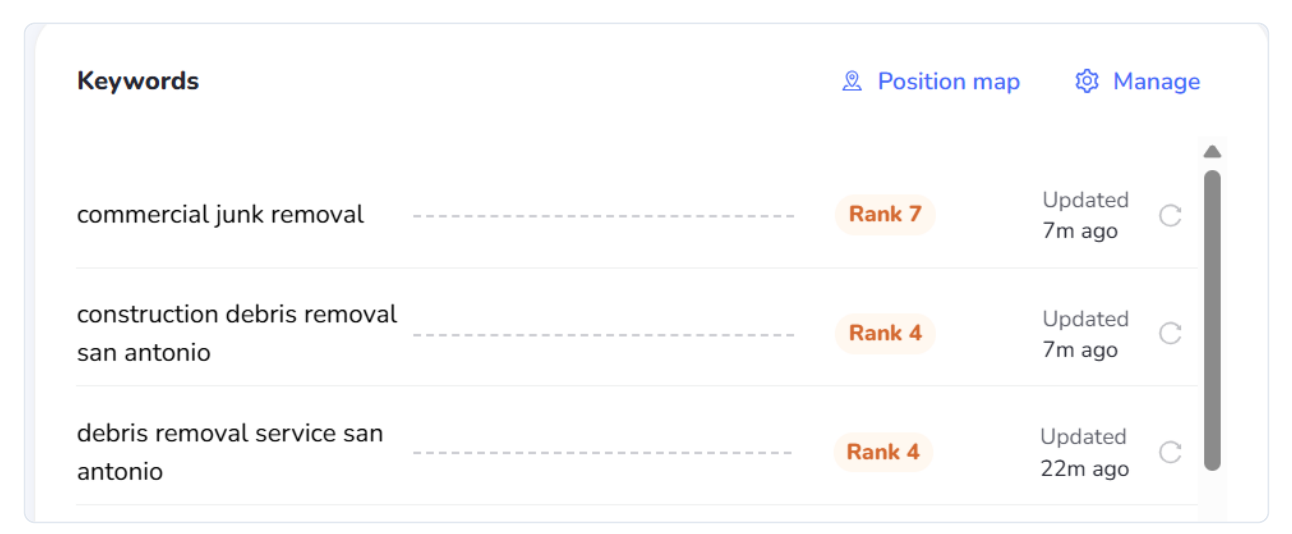
Tracked keyword ranks. Commercial junk removal at rank 7, construction debris removal san antonio at rank 4, debris removal service san antonio at rank 4. These are the searches that bring in larger contract jobs rather than single item pickups.
What changed between June and July
- The site became readable to Google. Indexing fixes meant service pages could finally be crawled, matched and ranked instead of sitting in a blind spot.
- The profile started describing the right business. Correct categories and service areas told Google which searches this company should appear for.
- Reviews started arriving steadily. Fresh reviews are a live ranking signal, not a vanity number, and the pace matters as much as the total.
- We aimed at the softer keywords first. Debris removal and demolition terms had lower competition than the head term but higher job value, so we took those spots before the fight got harder.
A note on timing. Nothing moved in the first four weeks, and that is normal. Local SEO results arrive in steps, not in a straight line. The work done in month one is what made months two and three possible.
Month three: number one across the city
On 7 September 2026 the grid for emergency debris removal service came back almost entirely green, with rank #1 at nearly every single point across San Antonio. Average grid rank: 1.4.
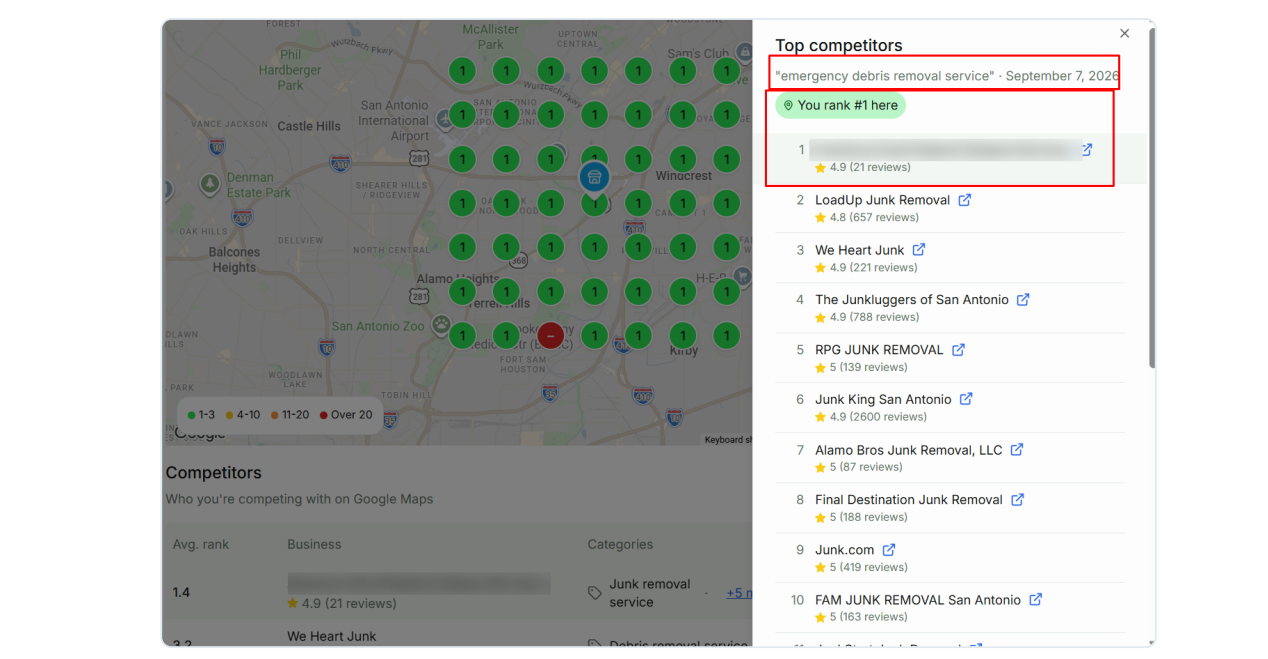
7 September 2026. Rank #1 at nearly every grid point for "emergency debris removal service". The competitor list on the right shows who the client is now sitting above: LoadUp, We Heart Junk, The Junkluggers, Junk King and Junk.com, all with hundreds or thousands of reviews.
On the broader head term junk removal service, which is far more competitive and defended by the national brands, the profile now holds an average grid rank of 7.8 and has started taking top three share. This is the term we expect to keep climbing next.
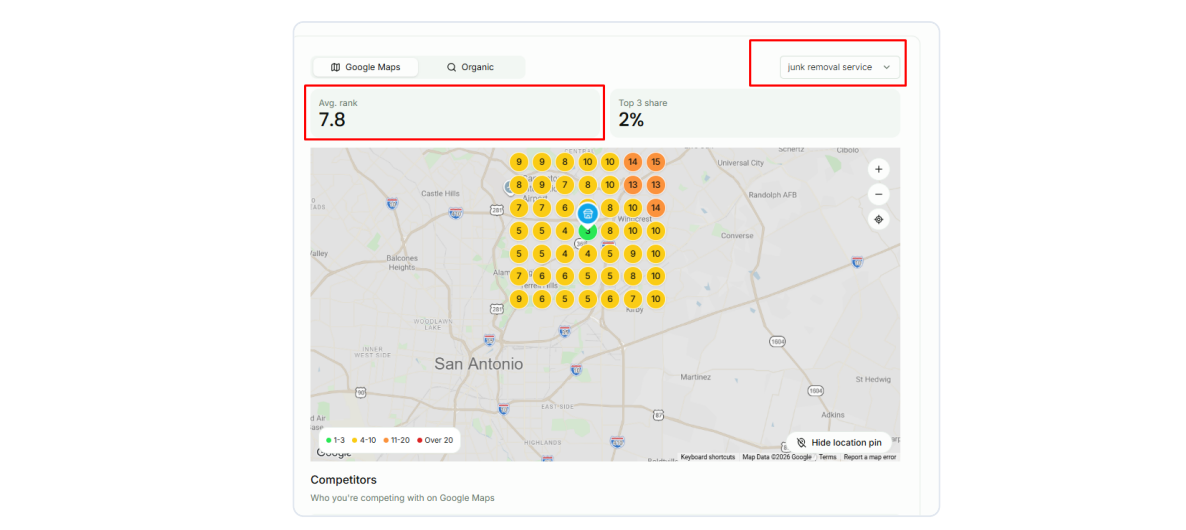
"Junk removal service" grid. Average rank 7.8 across the city, up from a starting point outside the top 20. Yellow points are positions 4 to 10, which means the business now appears on the first screen for most of San Antonio.
Outranking brands
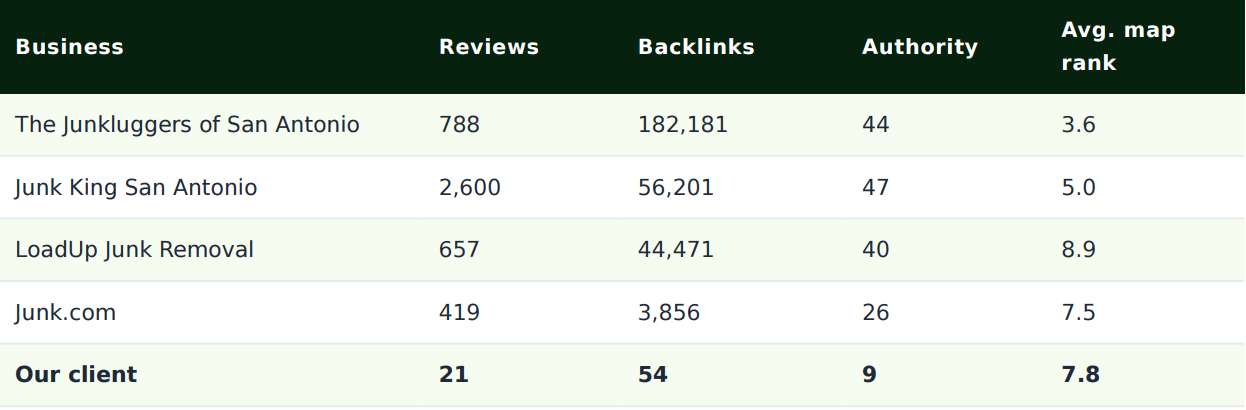
with 3,000 times more backlinks
This is the part of the campaign we are proudest of. The client sits inside the same competitive set as national franchises, with a fraction of their authority.
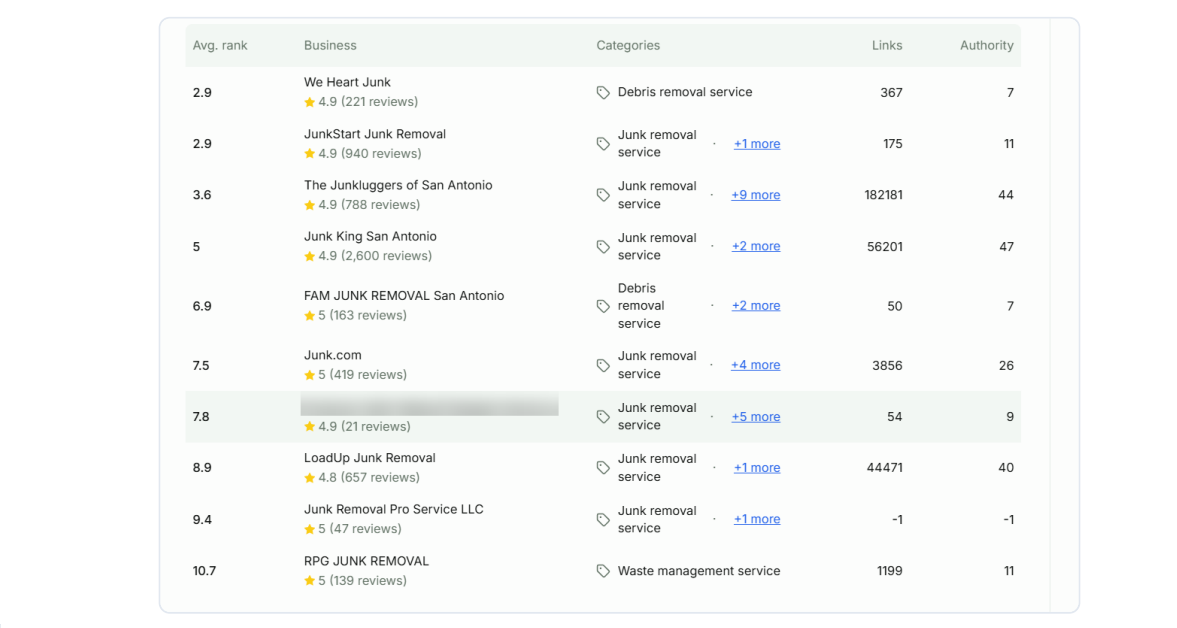
Google Maps competitor set for "junk removal service". The highlighted row is the client. Note the links and authority columns compared to the companies ranked around them.
How that is possible
Google Maps rankings are not decided by backlinks alone. They are decided by relevance, proximity and prominence. We could not out-link a national franchise in 90 days, so we won on the other two. Sharper category selection, tighter service area definition, matching business details everywhere, content that answers the exact questions San Antonio customers type, and a steady flow of fresh reviews. On the keyword where we combined all of that, the client ranks above every one of these brands.
The website side of the campaign
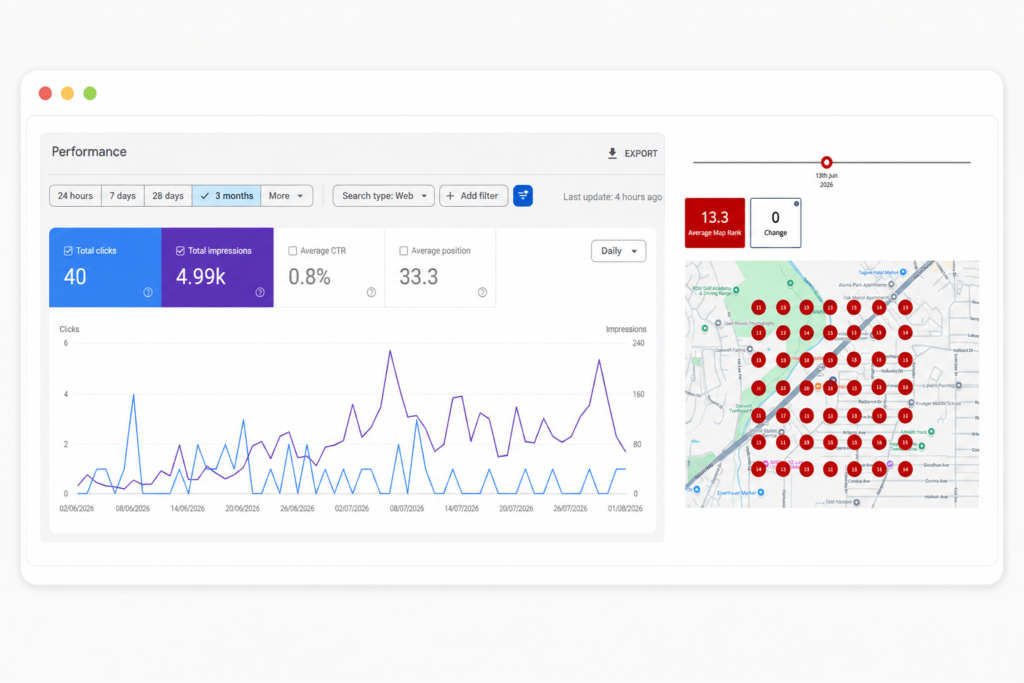
Maps moved first, which is normal for a local service business. The website followed. Across the 90 day window, Google Search Console recorded a steady climb in impressions as more pages entered the index and started matching more searches.
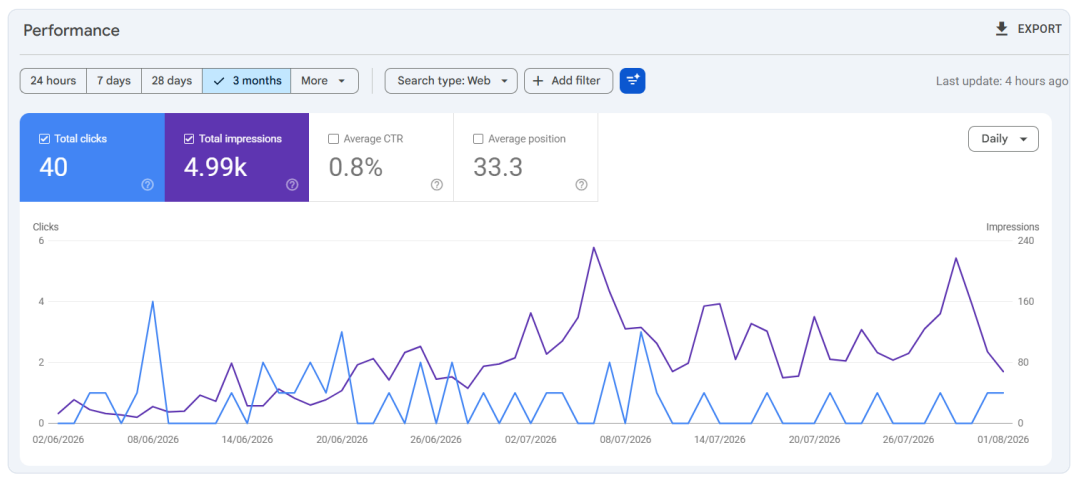
Google Search Console, 2 June to 1 August 2026. The purple line is impressions. It roughly triples across the period, with the clearest lift starting in early July once the technical fixes and first content cluster were live.
Reading these numbers honestly
An average position of 33.3 is not a winning position, and we are not going to dress it up as one. What it shows is a site that went from being invisible to Google to ranking for a growing set of keywords, mostly on pages two through four. That is exactly what the start of an organic campaign looks like. Impressions come first, positions climb, and clicks follow once pages cross into the top ten.
By August the site was ranking for 12 tracked keywords across 6 service pages, with 8 of those 12 rated low difficulty. The path from here is short, and the map results are already carrying the leads while the organic side matures.
The website side of the campaign
The message below came in unprompted. It is the moment that matters most in a campaign like this, when the ranking data turns into someone actually calling the business.

Unprompted client message. A prospective hire told the owner the website and Google presence looked professional. Rankings are the metric. This is the outcome.
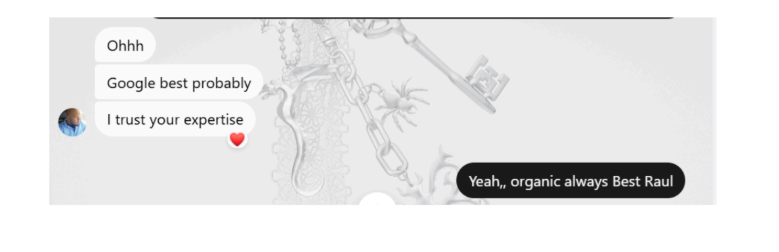
Follow up conversation about focusing the budget on organic and local search rather than paid ads.
Why this campaign worked
We fixed before we built
Technical repair and indexing came first. Content on a broken site earns nothing.
We published in priority order
A 328 article plan released in phases, starting with the clusters closest to a booking decision instead of publishing everything at once.
We picked winnable keywords first
Commercial terms like emergency debris removal had lower competition and higher job value than the obvious head term. We took those, built momentum, then moved up.
We used what made the business different
The veteran owned angle gave us a real reason for local sites and directories to link and feature the business.
We treated the map as the main channel
For a service business, the map pack is where the phone calls come from. The website supports it rather than the other way around.
We tracked everything weekly
Grid scans, keyword ranks and Search Console data reviewed on a schedule, so the plan adjusted to what the data was actually showing.
What comes next for this client
- Push the head term “junk removal service” from an average rank of 7.8 into the top three
- Expand the grid coverage outward into Schertz, Converse, Live Oak and Universal City
- Continue the content plan through the remaining clusters to build topical depth
- Keep the review pace steady, since review velocity is one of the strongest map signals
- Move organic average position from 33 into the top ten on the priority service pages
Next Step
Running a local service business that nobody can find?
This is the exact system I run for junk removal, hauling, construction and other local service companies. If your competitors are showing up on the map and you are not, let us look at your grid and find out why.